From Lees Ferry to Livingston: A Fly Fishing Guide’s Story
I’ve guided fly fishing trips across the West, from Lees Ferry on the Colorado River to the Lower Sacramento, Trinity, and Klamath Rivers, and eventually to Livingston, Montana. This is a personal story about how those waters shaped the way I fish, guide, and see the river in front of me.
Lees Ferry, Edward Abbey, and the Desert Rivers
I wasn’t part of the Livingston literary crowd of the 70s and 80s. I didn’t drink with Jim Harrison, argue with Thomas McGuane, or ride horses with Doug Peacock. And I didn’t roam the desert with Edward Abbey when he was writing about dams, rivers, and the kind of trouble that came from caring too much about wild places.
But in my own quieter way, I crossed paths with the same landscapes that shaped all of them.
Abbey spent time around Lees Ferry long before I ever lived there. Doug Peacock eventually came north to Livingston. Their stories moved between desert rivers and Montana valleys. Mine did too, just a few decades later and without the notoriety.
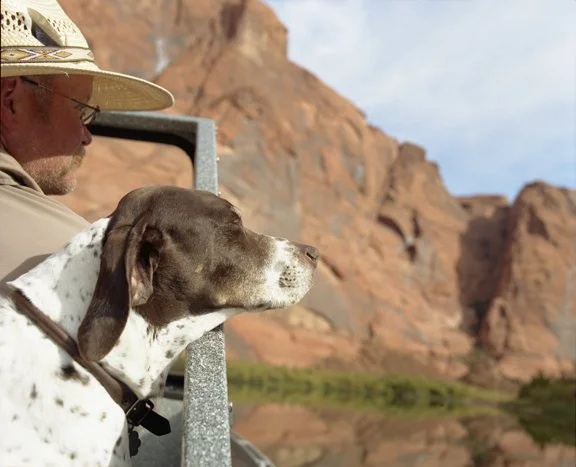
From 1999 to 2004, I lived and guided at Lees Ferry. Those years were the river’s heyday. The fishing was strong—big rainbow numbers, clear flows, and predictable windows when the fish would eat. Most of the feeding happened on the upflow, when aquatic insects were dislodged and pushed into the drift. You learned the river by watching how it carried food and how the fish responded. Nothing mystical. Just attention, repetition, and time.
Guide Culture at Lees Ferry
Lees Ferry also had a culture that was tight and demanding. Most mornings started in the dark at the ramp, jet boats lined up, engines idling, headlamps bobbing. We ran large Koffler inboard jet boats, and when the light finally came, it came fast. The canyon walls started as dark silhouettes and then slowly turned that deep vermilion red as the sun crept over the rim.
Those runs upriver at first light—35 knots by sight and memory—locked you in. There was noise, speed, and total focus. It felt a little like Apocalypse Now without the chaos. You didn’t think about much else. You just ran the line you knew and trusted.
There was a rivalry, but it was more or less a healthy one. It always reminded me of that old Looney Tunes cartoon with Ralph Wolf and Sam Sheepdog clocking in for work. On the river, it was all business. Everyone sharp. Everyone competitive. When the day was done and the boats were back on the trailers, the rivalry shut off. Off the river, we were all on the same side.
At one point, I even took a production crew upriver who were scouting locations for a possible film adaptation of The Monkey Wrench Gang. It felt fitting. Abbey’s book grew out of places like that—big desert rivers, dam fights, and people who believed the landscape was worth protecting even if it made them uncomfortable. After 9/11, anything that hinted at eco-terrorism lost momentum and the project faded. But that moment stuck with me. It tied Abbey, Peacock, and Lees Ferry together in a way I didn’t fully understand at the time.
The Fly Shop Years: Redding, the Lower Sacramento, and Steelhead Rivers
Before Montana became home, I also spent time guiding through The Fly Shop in Redding. That world was different again. Extremely professional. Extremely competitive. Less camaraderie, more pressure.
We fished large tailwaters on the Lower Sacramento, technical spring creeks, and steelhead rivers like the Trinity and Klamath. You had to be prepared every day. There wasn’t much margin. It was less fraternity and more performance. But it sharpened you. You stayed on your game or you didn’t last.
Those rivers added range. Big water management. Technical problem-solving. Patience where success isn’t guaranteed.
Why Paradise Valley and Livingston, Montana Became Home
Eventually, I started spending my summers guiding in Paradise Valley, Montana.
Montana was different from everything else that came before it. Not just culturally, but in the water itself. Lees Ferry was thirteen miles of consistent, technical fishing. The Lower Sacramento was big, efficient, powerful water. Montana was—and still is—everything at once.
Freestones, spring creeks, tailwaters, meadow rivers, canyon stretches, small tributaries, runoff, low water, hatches that change by drainage and by hour. You can’t fish Montana on autopilot. It forces you to adapt. It forces you to slow down. It forces you to learn different ways of reading water.
The guiding culture here is more polished and more gentrified, with less of the overt rivalry. But the depth is there if you look for it. And the longer I spent here, the more I realized this was the place where everything finally fit.
Lees Ferry taught me precision and edge.
Redding taught me professionalism and discipline.
Montana taught me range, patience, and perspective.
In a strange way, that mirrors the paths of Abbey and Peacock—desert to mountains, intensity to reflection. I’m not part of their story, and I don’t need to be. But I understand why they were drawn to these places.
These rivers shaped how I guide and how I live.
And of all of them, Montana is where it settled.
I wouldn’t trade my version of it for anything.